
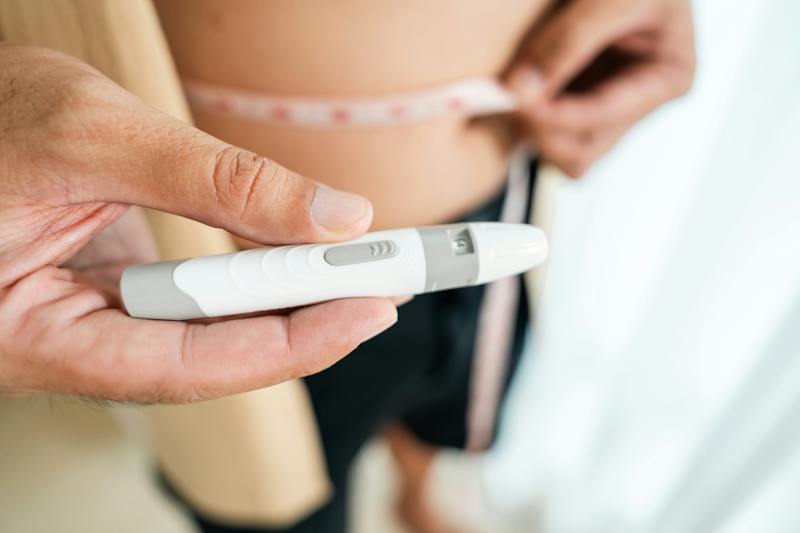
If you have lost weight on Ozempic, Wegovy, Mounjaro, or Zepbound, you have probably asked yourself what happens if you stop. Maybe the cost is adding up. Maybe your insurance changed. Or maybe you are simply thinking about what a long-term plan looks like.
It is an important question, and you deserve a straight answer.
How these medications work
Ozempic and Wegovy contain semaglutide. Mounjaro and Zepbound contain tirzepatide. Both act on hormones your gut releases after eating. They slow how fast your stomach empties, help regulate blood sugar, and send stronger "I'm full" signals to your brain.
The result is that you feel less hungry and eat less. For many people, that leads to meaningful weight loss.
The key point is that these medications work while you take them. They don't permanently change your body. When the medication leaves your system, the hormonal signals return to their previous levels.
What usually happens when you stop
Most people notice changes within a few weeks of their last dose:
- Hunger comes back. Appetite often returns to its previous level, and sometimes feels stronger.
- Portions grow. Without the feeling of fullness, it becomes harder to eat small meals.
- Weight starts to return. This is usually gradual, but steady.
Clinical research supports what many patients experience. In the extension of the STEP 1 trial, people who stopped semaglutide regained about two-thirds of the weight they had lost within one year. In the SURMOUNT-4 trial, people who switched from tirzepatide to a placebo regained a significant part of their lost weight, while those who stayed on the medication kept losing.
Why the weight comes back
Weight regain after stopping a GLP-1 is not a lack of willpower. Obesity is a chronic disease, and your body actively defends a higher weight.
When you lose weight, your body responds by increasing hunger hormones and lowering the amount of energy you burn. GLP-1 medications help keep those signals in check. Once the medication is gone, your body's defense system takes over again.
This is why so many patients describe the same experience: "It worked while I was on it, and then the weight came back."
What are your options?
If you are thinking about stopping, or have already stopped, there are several paths to consider with your doctor.
- Stay on the medication long term. This works well for many patients. It involves ongoing prescriptions, follow-up, and costs, which are worth planning for with your doctor.
- Lower the dose or switch medications. Some patients try a maintenance dose or a different GLP-1. Results vary, and this still means staying on medication.
- Focus on lifestyle changes alone. Nutrition, exercise, and behavior changes matter for everyone. On their own, they are often not enough to hold back the body's biological push to regain.
- Consider bariatric surgery. Procedures like the gastric sleeve change the size of the stomach and the hormones that control hunger. Unlike medication, these changes don't stop when a prescription ends.
Renting vs owning your weight loss
A helpful way to understand the difference: GLP-1 medications are like renting your weight loss. They are effective, but the results last as long as you keep taking them. When the medication stops, the effect stops too.
Bariatric surgery is closer to owning it. A one-time procedure creates lasting changes in how your body handles hunger and fullness. It still requires new eating habits, follow-up care, and support, but it doesn't depend on an ongoing prescription.
Neither approach is wrong. Medication can be the right choice for the short and medium term, and for some patients it is part of a plan that later includes surgery. The question is what you want your long-term plan to be.
When to talk to a bariatric surgeon
It may be time for a consultation if:
- You regained weight after stopping a GLP-1
- You can't afford to stay on your medication long term
- Your insurance stopped covering it
- You had side effects that made it hard to continue
- You want a solution that doesn't depend on ongoing prescriptions
A consultation doesn't commit you to surgery. It helps you understand whether you are a candidate and which option makes the most sense for your body and goals.
The bottom line
Stopping Ozempic, Wegovy, Mounjaro or Zepbound often brings hunger and weight back, because these medications only work while you take them. That isn't a personal failure. It is how the body responds.
If you want a more durable path, bariatric surgery may be worth exploring. At Obesity Control Center in Tijuana, just minutes from San Diego, Dr. Ariel Ortiz and his team help patients from across the U.S. find a long-term solution. Financing options are available.
Related reading: I'm Taking a GLP but I've Stopped Losing Weight. What Are My Options? · Can You Have Gastric Sleeve Surgery After Taking a GLP?
Sources: STEP 1 extension — Wilding et al., Diabetes, Obesity and Metabolism, 2022 · SURMOUNT-4 — Aronne et al., JAMA, 2024
This article is for educational purposes and does not replace medical advice. Don't start, stop or change any medication without talking to your doctor.